Through the InnoFiber laboratory at the Centre for Textile Science and Technology (2C2T), the University of Minho is committed to developing high-quality yarns made from textile waste.
The focus covers both post-industrial waste, such as cutting and spinning leftovers, and post-consumer waste from discarded garments. The ambitious goal is to create recycled yarns with higher quality, a greater percentage of recycled content, and optimised properties for producing fabrics, knits, and garments.
“Our main objective in the Lusitano Project is to develop new solutions, methodologies and treatments to improve the properties of these fibres, which will then be used to produce new recycled yarns,” explains Diana Ferreira, researcher and coordinator of InnoFiber, emphasising that this enables the development of yarns “with a higher percentage of recycled material and improved properties, so the final piece can also be of excellent quality.”

At this stage of the project, efforts are focused on three main areas, starting with the removal of elastane – one of the most challenging fibres to recycle, according to the researcher. “We have been working extensively on improving fibre processes, particularly in reducing elastane, which presents a significant challenge in recycling processes, especially mechanical recycling,” she notes.
A second line of work involves fibre separation, as waste often arrives in complex blends, such as cotton with polyester or viscose with wool. “We work on chemical, physical and biological separation of various binary and tertiary blends,” she says.
Lastly, fibre functionalisation is also a priority, with the application of solutions that enhance cohesion between fibres and optimise yarn formation. “We can apply aqueous solutions of specific salts, and even biopolymers, to increase fibre cohesion. For example, biopolymers can act as anchoring agents between the fibres,” she explains. However, she warns, “we must be cautious, as sometimes the fibres cannot be too sticky, as that would hinder the process,” referring to the impact on the feel and quality of the yarn.
In fibre treatment, the laboratory is committed to avoiding toxic solvents, often cited in scientific literature. “We aim to use cleaner, greener, more ecological processes. We use aqueous salt solutions to remove most of the elastane,” she highlights.
The research team has already produced various demonstrators, including yarns, knits, fabrics and nonwovens. Partner companies in the consortium, such as Calvelex, Paulo de Oliveira, Polopiqué, Riopele, and Twintex, provide industrial waste in the form of cutting or spinning scraps. These materials are processed by the research teams using defibring techniques, elastane removal and functional treatments, resulting in recycled fibres ready to be spun into new yarns. These raw materials are then returned to the companies to test and adapt the processes at an industrial scale. This industrial validation phase, the researcher explains, is essential to ensure that the solutions developed in the lab are feasible in real production settings.
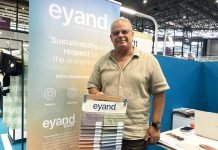
 Diana Ferreira (in the centre)
The final stage of the process is in the hands of the consortium’s garment manufacturers, such as Twintex and Calvelex, who are already developing clothing collections. These garments will be made entirely from the yarns and fabrics created within the project, respecting the principles of eco-design – a concept that promotes sustainability from product design to end-of-life. “Each company develops internal products so the process can be industrialised,” says Diana Ferreira.
Despite the progress, there are still several challenges to overcome, acknowledges Diana Ferreira. One of the most demanding is the treatment of complex textile blends, which requires separating materials without compromising fibre integrity. “If we want, for example, to break down cellulose in a polyester-cotton blend, we need to use stronger acids, which must be replaced by greener solvents. So, it involves extensive research,” she points out.
It’s also not easy to define fixed targets for recycled content percentages. “When we talk about 100% recycled, we always have to consider what losses occurred in the processes, and where the waste came from – so it’s very relative,” she cautions.
Still, the ambition is clear. “I’d be very pleased if we could reach yarns with 40% to 50% recycled content – even if it’s 50% or 40% – without losses in the process and with properties suitable for structure development,” she highlights.
More important than reaching symbolic figures, Diana Ferreira believes, is ensuring product quality, future recyclability, and genuine sustainability. “There’s no need to aim for 100% if it’s not feasible – and perhaps that 100% recycled yarn won’t even be recyclable,” she argues.
Softer Linen and Hemp
These two natural fibres are at the centre of work by the Fibrenamics platform, with progress being made in reducing stiffness and thus improving the handle.

The aim, according to Liliana Leite, project manager for fibrous materials at Fibrenamics, is to refine the processing of linen and hemp fibres by applying chemical and enzymatic treatments to reduce stiffness and enhance process sustainability.

So far, efforts have focused particularly on hemp fibres, known to be stiffer and harder to process than linen fibres. This stiffness is a barrier to producing textile yarns with market-appropriate properties, requiring innovative and environmentally responsible solutions, she stresses.
To address this limitation, the Fibrenamics team has been developing and applying different combinations of solutions. The results have been promising, she assures. “We’ve already achieved a 50% to 60% reduction,” says Liliana Leite, noting that this marks a significant step towards making hemp fibres viable in more demanding industrial processes.
 Liliana Leite
Beyond the technical component, one of the main pillars of Fibrenamics’ work is the sustainability of the treatments used. The project aims to replace traditional methods, often based on aggressive chemicals and high-energy processes, with more ecological and efficient alternatives that minimise environmental impact and maximise the use of natural resources.
This approach has already resulted in yarns produced from treated materials, validating the processes at a laboratory scale. These yarns have also demonstrated satisfactory mechanical and structural properties, reinforcing the technical viability of the concept.
With this validation successfully completed, Fibrenamics’ focus until the end of the project is to test the scalability of the developed treatments. “Having already validated the processes and treatments at laboratory level, the key objective is now to scale up these same treatments and confirm their scalability so they can later be applied at industrial level,” states the project manager for fibrous materials at Fibrenamics.